What Is a Public Adjuster? How Public Adjusters Help Insurance Claims
Definitive Guide to Public Adjuster Services: Maximize Your Property Insurance Claims with Expert Advocacy


Experiencing significant property damage can create financial uncertainty, operational disruption, and complex insurance claim challenges for commercial property owners, multifamily operators, businesses, and policyholders. Understanding how the insurance claim process works — and how public adjusters assist policyholders — can significantly impact claim outcomes, documentation quality, and settlement positioning.
A public adjuster is a licensed insurance claims professional who represents the policyholder — not the insurance company — during the insurance claim process. Public adjusters help policyholders document damages, interpret insurance policy language, organize claim documentation, evaluate losses, and negotiate insurance settlements.
For large-loss commercial and multifamily claims, early claim strategy and documentation often influence the direction and valuation of the insurance claim long before settlement discussions begin. Public adjusters provide policyholder advocacy designed to improve claim organization, support thorough documentation, and help navigate complex property insurance claims efficiently and strategically.
This is where a public adjuster becomes an essential advocate. A public adjuster is a licensed insurance professional who represents you—the policyholder—exclusively, not the insurance company or their independent adjusters. Their role is to provide expert policyholder representation, ensuring your insurance claim is thoroughly documented, strategically presented, and aggressively negotiated to maximize your insurance settlement and expedite claim resolution.
Claim outcomes, especially for large-loss commercial and multifamily claims, are often determined early in the process, making timely and expert involvement critical. Public adjusters bring extensive experience managing complex insurance claims involving commercial properties, multifamily housing, apartment complexes, and business interruption losses. This guide offers a comprehensive overview of public adjusters, their role in commercial and multifamily insurance claims, when to hire one, and how they help policyholders recover the full value of their claims without unnecessary litigation or prolonged disputes.
Whether you are a commercial property owner, multifamily property manager, apartment complex operator, or business owner, understanding the role of a public adjuster empowers you to protect your rights and optimize your insurance recovery during one of the most challenging events involving property damage and insurance claims.
What Is a Public Adjuster?
A public adjuster is a licensed insurance professional who advocates exclusively for policyholders during the insurance claims process. Unlike insurance company adjusters, whose responsibility is to protect the insurer’s financial interests, public adjusters work solely on behalf of the insured party.
Public adjusters assist policyholders with:
• Damage evaluation
• Insurance policy interpretation
• Claim documentation
• Proof of loss preparation
• Supplemental claims
• Business interruption documentation
• Insurance carrier negotiations
• Settlement strategy
Public adjusters are commonly involved in:
• Commercial property insurance claims
• Multifamily insurance claims
• Apartment complex losses
• Fire damage claims
• Hail and storm claims
• Water damage claims
• Hurricane claims
• Business interruption claims
• Large-loss property claims
What Does a Public Adjuster Do?
Public adjusters provide strategic claim management services designed to help policyholders navigate complex insurance claims efficiently and thoroughly.
Damage Assessment: Public adjusters conduct detailed inspections to identify visible and hidden damages, including structural issues, code upgrade exposure, secondary water damage, roofing damage, HVAC contamination, and other overlooked claim components.
Documentation: Comprehensive documentation is critical to successful insurance claims. Public adjusters help organize:
• Photographs and videos
• Contractor estimates
• Engineering reports
• Mitigation documentation
• Repair scopes
• Code upgrade requirements
• Financial records for business interruption lossesClaim Preparation: Public adjusters assist with:
• Proof of loss preparation
• Supplemental claims
• Scope development
• Damage inventories
• Insurance claim organization
• Claim presentation strategyNegotiation: Public adjusters negotiate directly with insurance carriers to address:
• Underpaid claims
• Incomplete scopes
• Reserve assumptions
• Supplemental damages
• Business interruption positioning
• Code upgrade disputesClaim Strategy: Public adjusters help policyholders develop tailored strategies to maximize insurance recovery, including multi-line coverage coordination, mitigation documentation, and settlement positioning.
By managing these critical steps, public adjusters help policyholders avoid common pitfalls, reduce claim processing delays, and ensure claims are handled efficiently and effectively to achieve optimal insurance settlements.
Who Does a Public Adjuster Work For?
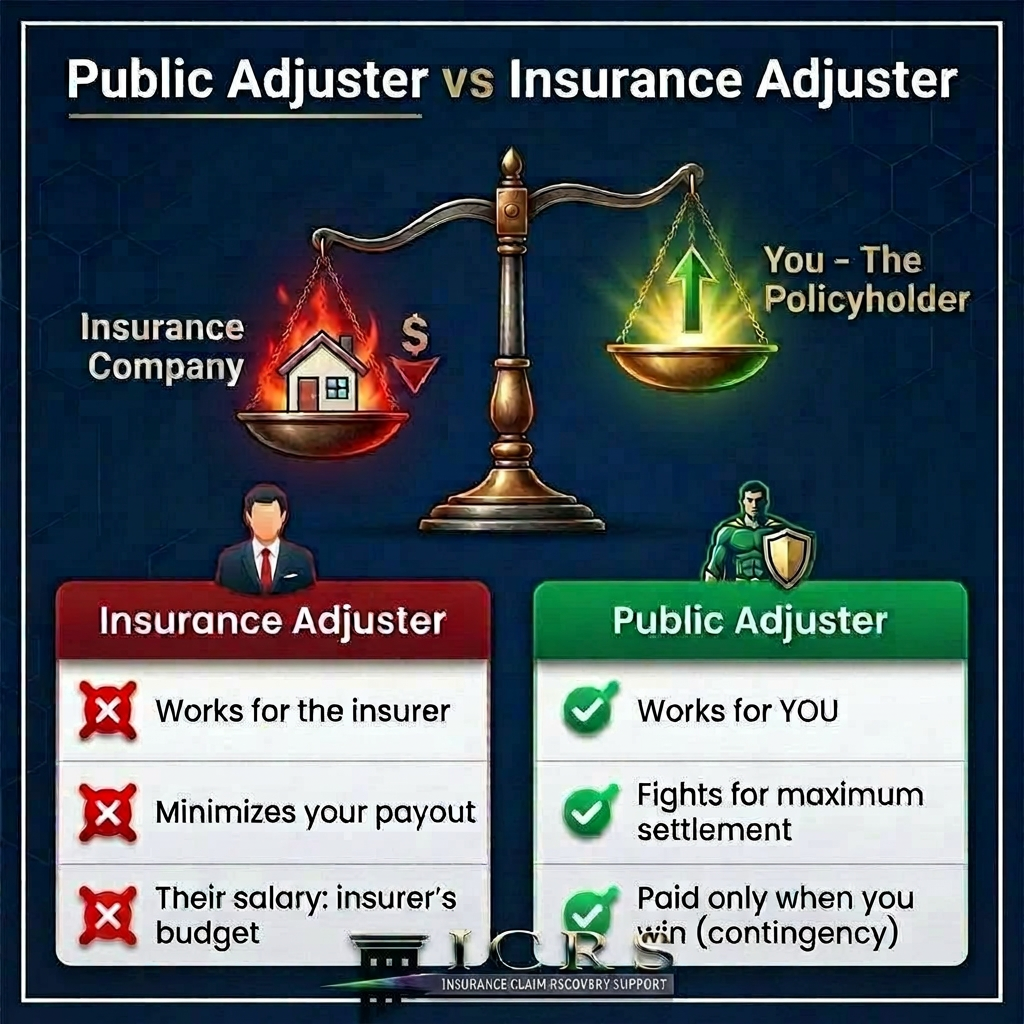
Public adjusters work exclusively for the policyholder — not the insurance company. Their responsibility is to advocate for the insured party’s interests throughout the claim process.
Insurance company adjusters represent the carrier. Public adjusters represent the policyholder.
This distinction is especially important in commercial, multifamily, and large-loss claims where documentation quality, reserve assumptions, and scope development can significantly affect settlement outcomes.
When Should You Hire a Public Adjuster?
Many policyholders engage a public adjuster immediately after property damage occurs to help establish early claim strategy and preserve documentation before repairs begin.
Timing is crucial in insurance claims, especially for large-loss commercial and multifamily property claims. Hiring a public adjuster early—ideally immediately after property damage occurs or when you anticipate filing a claim—can significantly improve your outcome.
Early involvement may help:
• Improve documentation quality
• Reduce overlooked damages
• Assist with claim organization
• Improve communication efficiency
• Support business interruption evaluations
• Position supplemental claims appropriately
• Assist with emergency mitigation to prevent further damage, such as water extraction, tarping, and temporary repairs.
• Document losses comprehensively before repairs or debris removal begin, preserving critical evidence for claim substantiation.
•. Engage with insurance company adjusters from the outset to influence reserve estimates, scope of damage, and claim strategy.
Public adjusters can also assist if you’ve already filed a claim but feel your settlement is inadequate or your claim was denied. They can reopen claims, file supplemental claims for overlooked damages or code upgrades, and negotiate disputes often without unnecessary litigation or appraisal.
Public adjusters may also assist policyholders after a claim has already been filed if:
• Settlement offers appear incomplete
• Damages were overlooked
• Claims were delayed
• Supplemental damages are discovered
• Claims are underpaid or disputed
Public Adjusting Representation
Best For
Large-loss commercial and multifamily claims typically exceeding $250,000 after deductible
Fee Structure
Contingency-based representation
What It Provides
• Claim documentation and organization
• Damage evaluation and review
• Policyholder representation
• Insurance carrier negotiation
• Settlement strategy and claim management
• Supplemental claim support when applicable
ClaimNavigator Advisory Services
Best For
Smaller property damage insurance claims and policyholders seeking strategic guidance
Fee Structure
Flat-fee advisory and consultation services
What It Provides
• Insurance claim guidance
• Documentation strategy
• Estimate review insight
• Policyholder education
• Claim consultation and recovery planning
• Assistance understanding the insurance claim process
Commercial Property and Multifamily Insurance Claims
Commercial and multifamily insurance claims often involve:
• Multiple buildings or systems
• Complex policy language
• Large repair scopes
• Business interruption exposure
• Code upgrade requirements
• Engineering evaluations
• Significant financial exposure
Public adjusters experienced in commercial and multifamily claims help policyholders organize documentation, coordinate with contractors and consultants, and develop claim strategies designed to support accurate and comprehensive insurance recovery.
Qualifying Large-Loss Claims and Complimentary Evaluations
Qualifying large-loss claims is a crucial process within the insurance and risk management industries, particularly when dealing with significant losses that can greatly impact a business’s financial stability. A large-loss claim typically involves substantial monetary amounts, often arising from incidents such as natural disasters, major accidents, or extensive property damage. To qualify these claims, it is vital to gather detailed documentation, assess the extent of the loss, and evaluate the policy terms thoroughly. This process not only ensures that the claim is legitimate but also helps insurers and policyholders arrive at a fair settlement. Proper qualification of large-loss claims can also prevent the potential for fraud and disputes, which can significantly complicate and prolong the claims process.
In tandem with qualifying large-loss claims, complimentary evaluations provide an essential service, helping policyholders understand the magnitude of their losses and the viability of their claims. During these evaluations, experts analyze the extent of damages, recommend necessary repairs, and assist clients in preparing their case for submission. This proactive approach not only enhances the chances of a successful claim but also equips clients with valuable knowledge regarding their policy coverage and rights. By offering complimentary evaluations, insurers can foster transparency and trust, ultimately leading to stronger client relationships. In the high-stakes realm of large-loss claims, these evaluations act as a vital tool for both policyholders and insurers, ensuring that everyone involved is equipped with the information needed to navigate the complexities of the claims process effectively.
Policyholders dealing with qualifying large-loss commercial and multifamily insurance claims may be eligible for complimentary claim evaluations by experienced public adjusters. These evaluations provide a detailed review of your claim’s scope, documentation, and potential recovery, helping you understand your rights and options without upfront cost.
For smaller property damage claims, ClaimNavigator offers flat-fee advisory and consultation services designed to provide strategic insurance claim guidance, documentation support, and policyholder education. This service is ideal for policyholders seeking expert advice without full public adjusting representation.
Commercial Property Insurance Claims and Multifamily Insurance Claims
Commercial and multifamily insurance claims often involve complex policy language, multiple coverage lines, and significant financial exposure. These claims typically include property damage, business interruption losses, liability claims, and code upgrade requirements. Public adjusters with specialized expertise in these sectors understand how to navigate insurance carrier adjustment processes, coordinate with contractors and engineers, and develop comprehensive claim strategies to maximize insurance recovery.
Key Considerations in Commercial and Multifamily Claims
Large-Loss Claim Management: Handling claims exceeding $250,000 with detailed damage scopes and reserve estimate challenges.
Business Interruption Exposure: Documenting lost income and extra expenses with financial experts to support claim valuation.
Replacement Cost Valuation: Ensuring claims reflect full replacement costs without depreciation.
Engineering Reports and Code Upgrades: Utilizing expert assessments to substantiate repair needs and code compliance costs.
Mitigation Documentation: Recording emergency repairs and loss prevention efforts to support claim validity.
Commonly Overlooked Issues in Insurance Claims
Fire Claims
• Smoke and soot contamination
• HVAC contamination
• Odor remediation
• Code upgrades
• Hidden structural damage
Hail Claims
• Roofing systems
• Soft metals
• Gutters and downspouts
• Window damage
• Siding impacts
Water Damage Claims
• Hidden moisture
• Flooring damage
• Insulation damage
• Mold and microbial risk
• Secondary structural impacts
Business Interruption Claims
• Lost income
• Extra expenses
• Restoration period disputes
• Temporary operational costs
• Financial documentation gaps
By recognizing these commonly overlooked issues, policyholders can seek the appropriate support, whether through public adjusting or advisory services, to enhance their claims and ensure a fair settlement process.
Why Insurance Claims Become Underpaid or Disputed
Insurance claims are commonly underpaid due to:
• Incomplete damage documentation
• Overlooked supplemental damages
• Conservative reserve estimates
• Narrow policy interpretations
• Inadequate business interruption evaluations
• Missing code upgrade documentation
Public adjusters help policyholders prepare detailed documentation designed to support accurate claim valuation and reduce claim disputes.
Common Mistakes Policyholders Make After Property Damage
• Delaying claim documentation
• Accepting early settlement offers without review
• Failing to document all damages
• Making repairs before inspections
• Overlooking code upgrades
• Underestimating business interruption exposure
• Misunderstanding policy coverage
Avoiding these issues early can significantly improve claim organization and settlement positioning.
Why Documentation Matters
Successful insurance claims depend heavily on thorough documentation.
Important documentation often includes:
• Photographs and videos
• Contractor estimates
• Engineering reports
• Mitigation invoices
• Financial statements
• Proof of loss documentation
• Repair scopes
• Code compliance requirements
Detailed documentation helps reduce disputes and improves claim clarity throughout the adjustment process.
Business Interruption Claims
Business interruption claims can be among the most complex portions of commercial property insurance claims.
These claims often involve:
• Lost income calculations
• Extra expense documentation
• Restoration period analysis
• Financial statement review
• Operational impact analysis
Public adjusters often coordinate with accountants, consultants, and financial professionals to help support business interruption documentation and positioning.
Property DamageClaim Strategy:
A Process-Oriented Approach
Immediate Response and Mitigation: Implement emergency measures to prevent further damage, such as tarping roofs and water extraction.
Comprehensive Damage Assessment: Conduct detailed inspections to identify all visible and hidden damages, including structural and secondary issues.
Documentation and Proof of Loss Preparation: Compile photographic evidence, contractor estimates, engineering reports, and prepare formal proof of loss statements.
Claim Submission and Negotiation: Submit detailed claims and negotiate assertively with insurance adjusters to challenge low reserve estimates and underpayments.
Supplemental Claims and Settlement Positioning: File additional claims for overlooked damages, code upgrades, and mitigation costs; position business interruption claims effectively.
Dispute Resolution and Claim Closure: Address disputes through negotiation or mediation; finalize settlements and assist with claim appeals or reopening if necessary.
What Happens During the First 30 Days of an Insurance Claim?
The initial 30 days after a loss are critical for claim success. Here’s a timeline of key activities:
Day 1–3: Immediate Response and Mitigation
Emergency mitigation to prevent further damage (e.g., tarping roofs, water extraction). Initial contact with insurance company and public adjuster engagement. Begin documenting damages thoroughly with photos, videos, and notes.
Week 1–2: Inspection and Documentation
Insurance adjuster inspections and reserve estimate establishment. Public adjuster conducts independent damage assessments, gathers engineering and contractor reports, and identifies scope assumptions and potential documentation gaps.
Month 1+: Claim Strategy and Negotiation
Develop claim strategy including supplemental claims for hidden damages, code upgrades, and mitigation costs. Begin negotiation with insurance companyadjusters. Position business interruption claims if applicable, coordinating with financial experts.
Month 2+: Settlement Positioning and Resolution
Address disputes or underpayments through negotiation or mediation. Finalize documentation and negotiate settlement terms. Public adjuster may assist in reopening claims or filing appeals without unnecessary litigation or arbitration.
Request a Claim Evaluation
Qualifying commercial, multifamily, and large-loss property insurance claims may be eligible for contingency-based public adjusting representation.
For smaller property damage claims, ClaimNavigator offers flat-fee advisory and consultation services designed to help policyholders navigate the insurance claim process strategically and efficiently.
How Public Adjusters Help Maximize Insurance Recovery
Public adjusters maximize recovery by:
Uncovering hidden or overlooked damages, including secondary water damage and code upgrade requirements.
Challenging low reserve estimates and insurance company assumptions with detailed evidence.
Preparing detailed proof of loss and supplemental claims to capture all losses.
Negotiating assertively to secure fair settlements and expedite claim resolution.
Providing expert guidance throughout the claim timeline, including documentation, inspections, and dispute resolution.
Realistic Commercial and Multifamily Claim Examples Demonstrating Public Adjuster Impact
Commercial Property Fire Loss
A commercial property owner suffered extensive fire damage. The insurance company’s initial estimate overlooked smoke damage, structural repairs, and code upgrade costs. The public adjuster documented these hidden damages, secured engineering reports, and negotiated a settlement 40% higher than the insurer’s offer, including business interruption and additional living expenses coverage.
Apartment Complex Hail and Storm Damage
An apartment complex experienced severe hail and wind damage. The insurer’s adjuster underestimated roof and siding replacement costs and overlooked debris removal expenses. The public adjuster provided detailed scope documentation, mitigation records, and contractor estimates, resulting in a settlement increase of over $500,000.
Commercial Property Water Damage and Business Interruption
A commercial property owner faced water damage and business interruption losses. The public adjuster coordinated with financial experts to document lost income, extra expenses, and repair costs, successfully negotiating a comprehensive settlement covering both property damage and business interruption claims.
Denied Claim for Hidden Damages in Multifamily Property
A multifamily property owner’s claim was denied due to alleged lack of evidence. The public adjuster uncovered overlooked damages through engineering assessments and reopened the claim, securing a favorable settlement without unnecessary litigation or arbitration.
Request Your Insurance Claim Evaluation Today
Don’t navigate the complex insurance claims process alone. Contact our expert public adjusters for a claim evaluation. Protect your rights and maximize your insurance recovery with trusted advocacy and comprehensive claim management.
Frequently Asked Questions
About Public Adjusters and Insurance Claims
What is a public adjuster?
A public adjuster is a licensed insurance professional who represents policyholders during the insurance claims process.
Can a Public Adjuster Reopen a Claim?
Yes. If overlooked damages or supplemental issues are discovered after a settlement, public adjusters may assist policyholders with supplemental claims or reopening portions of a claim when permitted under the policy.
Do Public Adjusters Help With Denied Claims?
Public adjusters may assist policyholders by reviewing denied or underpaid claims, identifying documentation gaps, evaluating overlooked damages, and preparing supplemental documentation for reconsideration or negotiation.
Should You Hire a Public Adjuster Before or After Filing a Claim?
Hiring a public adjuster before filing a claim is ideal to ensure proper documentation, claim strategy, and mitigation from the start. However, if you’ve already filed a claim and are dissatisfied with the process or settlement, hiring a public adjuster after can still provide significant benefits, including reopening claims and negotiating supplemental settlements.
How does a public adjuster differ from an insurance company adjuster?
Insurance company adjusters work for the insurer. Public adjusters work for the policyholder.
When should I hire a public adjuster?
Many policyholders consider engaging a public adjuster immediately after property damage occurs, especially for complex or large-loss claims. Ideally immediately after damage occurs or before filing a claim, but they can also help after a claim is filed, denied, or underpaid.
How are public adjusters paid?
Public adjusters commonly work on a contingency fee basis for qualifying large-loss claims. Typically on a contingency fee basis, receiving a percentage of the final settlement, aligning their interests with yours.
Do public adjusters increase insurance settlements?
Yes, claims handled by public adjusters often result in significantly higher settlements due to expert documentation and negotiation.
What is ClaimNavigator?
ClaimNavigator is a flat-fee insurance claim advisory and consultation service designed for smaller property damage insurance claims.
Can public adjusters help with denied or underpaid claims?
Yes. Public adjusters may assist with supplemental documentation, claim review, and settlement negotiation for disputed or underpaid claims.
What types of claims do public adjusters handle?
Commercial, multifamily, large-loss, fire, hail, storm, water damage, business interruption, liability, and more.
What is a proof of loss?
A formal document submitted to the insurer detailing the damages and amount claimed, essential for claim processing.
Why is documentation important in insurance claims?
Thorough documentation supports your claim, proving the extent of damages, repair costs, and additional losses.
What are supplemental claims?
Additional claims filed after the initial settlement to cover overlooked or new damages discovered during repairs or inspections.
How long does the insurance claim process take?
It varies, but the first 30 days are critical for documentation and negotiations; full resolution can take several months depending on claim complexity.
What is business interruption insurance?
Coverage for lost income and extra expenses when a business cannot operate due to property damage, requiring detailed financial documentation.
Can a public adjuster help with multifamily or apartment complex claims?
Yes, they have specialized experience handling complex multifamily property claims involving multiple coverage lines and large-scale damages.
What are common mistakes to avoid after property damage?
Delaying claims, accepting low offers, poor documentation, making repairs before inspections, and misunderstanding policy coverage.
How do insurance companies estimate claim reserves?
They set preliminary payout amounts based on initial damage assessments and proprietary software, which can be challenged by public adjusters.
What is replacement cost valuation?
The cost to replace damaged property without depreciation, often a key factor in maximizing insurance settlements.
How do code upgrades affect insurance claims?
Upgrades required by current building codes can increase repair costs and are often covered if properly documented and claimed.
What role do engineering reports play in claims?
They provide expert assessments of damage and repair needs, strengthening claim documentation and supporting higher settlements.
Can a public adjuster help with insurance settlement disputes?
Yes, they negotiate and mediate disputes to reach fair settlements without unnecessary litigation or arbitration.
How can I verify a public adjuster’s license?
Check your state’s insurance department website for licensing, complaint history, and disciplinary actions.
Secure Your Insurance Claim Success with Expert Public Adjuster Support
Don’t leave your insurance claim to chance. Schedule a consultation with our experienced public adjusters today to protect your rights, ensure comprehensive claim documentation, and maximize your recovery through expert advocacy and strategic negotiation.
Additional Resources and Internal Links
Understanding Insurance Carrier Adjustment Processes
Insurance carriers follow structured adjustment processes designed to evaluate claims efficiently while managing costs. These processes include initial damage inspections, reserve setting, scope development, and settlement negotiations. Public adjusters understand these workflows and use their expertise to influence each stage in favor of the policyholder, ensuring accurate damage scopes and fair reserve allocations.
By anticipating insurance company tactics and preparing comprehensive documentation, public adjusters help ensure your claim is not undervalued, delayed, or denied.
Policyholder Rights and Advocacy
As a policyholder, you have rights to fair treatment, timely communication, and full compensation under your insurance policy. Public adjusters serve as your advocates, protecting these rights and guiding you through complex policy language, claim procedures, and dispute resolution.
With years of experience in large-loss claims, multi-line coverage coordination, and strategic settlement negotiation, public adjusters provide the expertise and peace of mind you need during difficult times involving property damage and insurance claims.
Schedule Your Consultation
Protect your interests and improve your insurance claim strategy with experienced policyholder advocacy and insurance claim guidance.